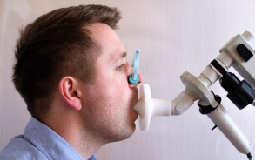
Pulmonary Function Testing
Full pulmonary function testing and six-minute walk testing, performed on site
About This Service
Pulmonary function testing measures how much air your lungs hold, how quickly you can move air in and out, and how well oxygen passes from your lungs into your bloodstream. Testing is performed on site using a Minibox+ system, which measures spirometry, lung volumes, and diffusing capacity (DLCO) without a sealed booth to sit inside. Lung volumes are recorded during about a minute of normal tidal breathing, and a full study usually takes about 45 minutes, including the coaching and rest periods between maneuvers. Because there is no cabin, testing is comfortable for patients who find enclosed spaces difficult and is accessible for patients who use a wheelchair. We also perform the six-minute walk test (6MWT), a separate study that measures how far you can walk in six minutes while we monitor your oxygen saturation and heart rate. It shows how your lungs perform during activity, which resting tests cannot capture, and is used to assess exercise capacity, detect oxygen desaturation with exertion, and qualify patients for supplemental oxygen or pulmonary rehabilitation. Dr. Hsieh interprets every study personally and reviews the results with you or with the referring office.
Who Should Consider This Service
Patients being evaluated for asthma, COPD, chronic cough, or unexplained shortness of breath, and patients who need lung function monitored over time — including those on biologic therapy, those with interstitial lung disease, and those with persistent symptoms after COVID-19. Testing is also used before surgery to assess operative risk and to measure how well a treatment is working. Six-minute walk testing is appropriate for patients whose breathlessness appears mainly with exertion, patients with interstitial lung disease or pulmonary hypertension being followed over time, and patients being evaluated for supplemental oxygen or pulmonary rehabilitation. We accept test-only referrals: another office can send a patient for a full PFT, a six-minute walk test, or both, and we return the report with Dr. Hsieh's interpretation to the referring provider.
Reviewed by Dr. Jerry Hsieh, MD — Board Certified in Pulmonary Medicine, Critical Care Medicine, and Internal Medicine
Last reviewed:
Common Questions
What does a pulmonary function test measure?
A complete pulmonary function test has three parts. Spirometry measures how much air you can blow out and how fast, which identifies obstruction as seen in asthma and COPD. Lung volume measurement determines the total amount of air your lungs hold, which identifies restriction as seen in interstitial lung disease. Diffusing capacity (DLCO) measures how efficiently oxygen crosses from the air sacs into the blood, which can be reduced in emphysema, pulmonary fibrosis, and pulmonary vascular disease. Together these tests distinguish between the major categories of lung disease and establish a baseline for tracking change over time.
What is the six-minute walk test?
The six-minute walk test measures how far you can walk on a flat indoor course in six minutes while we monitor your oxygen saturation, heart rate, and symptoms. It is a separate study from the breathing tests above, and it answers a different question: how your lungs and heart perform during activity rather than at rest. Some patients have near-normal numbers sitting still but drop their oxygen level walking, which only this test reveals. Results are used to gauge exercise capacity, to document whether you qualify for supplemental oxygen, to follow interstitial lung disease or pulmonary hypertension over time, and to assess candidacy for pulmonary rehabilitation. Wear comfortable walking shoes and bring any walking aid you normally use. You are allowed to slow down or stop and rest at any point. The test follows the American Thoracic Society guidelines for the six-minute walk test.
How should I prepare for the test?
Avoid smoking for at least one hour beforehand, avoid alcohol for at least four hours, and avoid a large meal for at least two hours. Wear loose clothing that does not restrict your chest or abdomen. If you use inhalers, ask whether to hold them before the test — short-acting bronchodilators are usually held for 4 to 6 hours and long-acting ones for 12 to 24 hours when the goal is to measure bronchodilator response, but do not stop any medication without checking with us first. If you are unwell on the day of your appointment, particularly with a respiratory infection, call us, because a recent illness can affect the results.
What is the test like, and how long does it take?
You will sit in a chair at a table with a soft clip on your nose, breathing through a mouthpiece. A technician coaches you through each maneuver, which includes breathing quietly and then taking a deep breath in and blowing out as hard and as long as you can. There are no needles and no medication unless bronchodilator testing is part of your study. The effort required can be tiring and may make you cough or feel lightheaded briefly, so there are rest periods between maneuvers. Plan on about 45 minutes for the full appointment. Because the Minibox+ system is cabinless, you are not enclosed in a booth at any point.
Can another office refer a patient for testing only?
Yes. We accept test-only referrals from primary care physicians, specialists, and surgical practices. The patient is scheduled for the study alone, without a separate consultation, and the completed report with Dr. Hsieh's interpretation is sent back to the referring office. Call (949) 424-6135 to arrange a referral or to ask which study is appropriate for your patient. If the results suggest that pulmonary follow-up would help, we will say so in the report and leave the decision to refer with you and your patient.
When will I get my results?
Dr. Hsieh interprets every study personally rather than relying on automated output alone. If you are seen in the office the same day, results are usually reviewed with you at that visit. For test-only referrals, the interpreted report is returned to the referring provider, typically within a few business days. Numbers are compared against reference values matched to your age, height, sex, and ethnicity, since what counts as normal varies considerably between individuals.
Schedule an Appointment
Contact our office or request an appointment online to get started.
Request Appointment (949) 424-6135Office Location
17305 Von Karman Ave, Ste 201Irvine, CA 92614
Mon – Fri, –